Price-weighting splits the Nikkei from the TOPIX
Two indices on the same news, in the same hours, moving three times apart. The split is in the construction: one is price-weighted, so a small set of high-priced AI and chip names moves it far more than they move the wider market.
The split, in one session
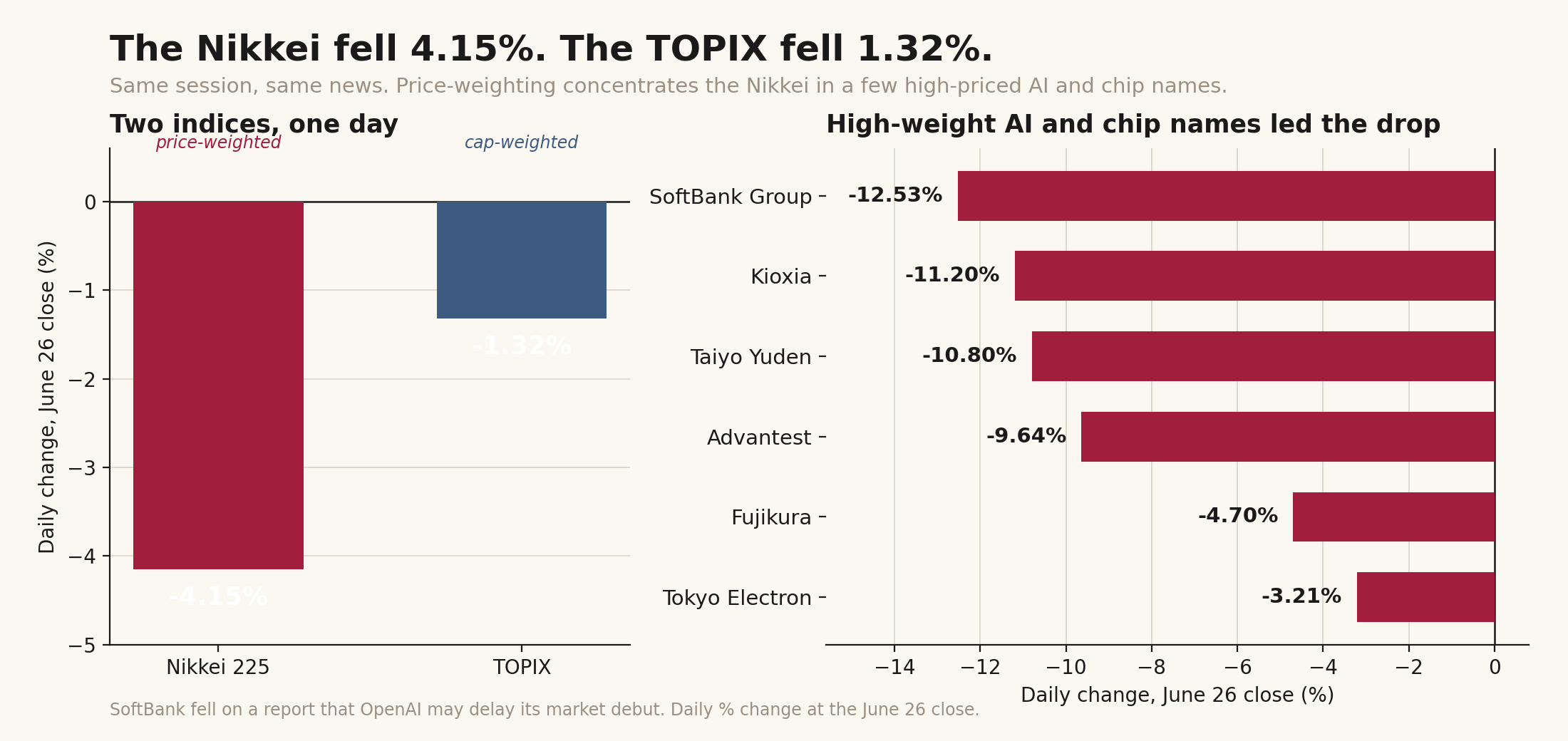
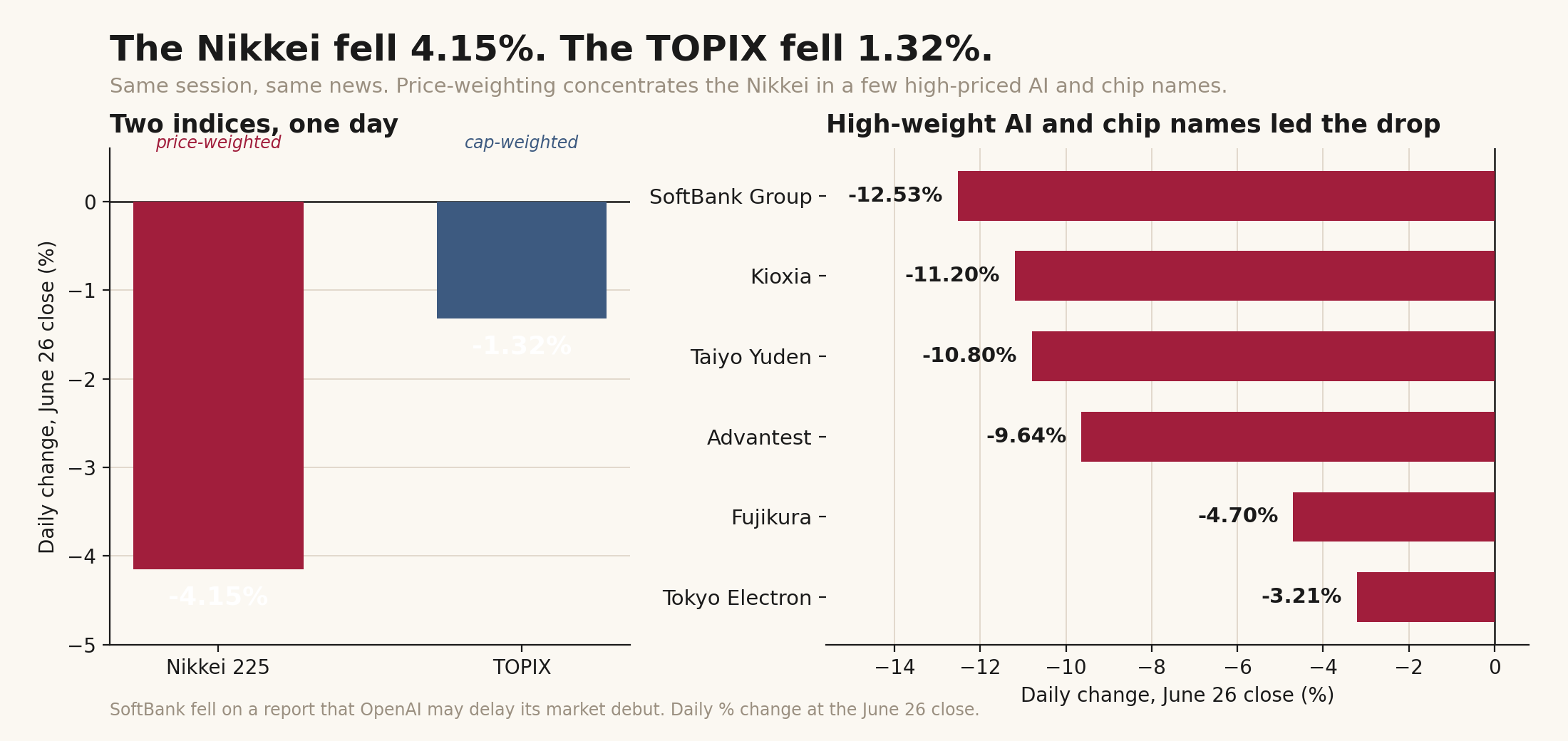
In June 2026 Japan's headline index and the broad market came apart. The Nikkei 225 fell 4.15 percent while the cap-weighted TOPIX fell 1.32 percent, on the same news and in the same hours. The Nikkei had set a record the session before and gave back a large piece of it, trading below 69,000 intraday. The trigger sat in one name. SoftBank Group, which investors treat as a listed proxy for OpenAI and Arm, dropped more than 12 percent on a report that OpenAI might delay its market debut. Other AI and chip heavyweights followed: Kioxia, Taiyo Yuden, Advantest, Fujikura, and Tokyo Electron all fell hard. The selling was regional, with Korea's Kospi triggering circuit breakers. One report about the timing of a US share sale moved a whole index by about four percent, carried through a handful of stocks.
How the Nikkei is weighted
The mechanism is in how the index is built. The Nikkei has been price-weighted since 1950. It sums the adjusted share prices of its 225 members and divides by a fixed divisor near 29.7, so a 100 yen move in one member's adjusted price shifts the index by about 3.37 points. Weight follows share price, independent of company size. That produces a roster the broad economy would not recognise. Toyota, far larger than Tokyo Electron by market value, carries a weight near 1.3 percent, while Tokyo Electron sits near 10 percent and ranks at the front of the index, on Nikkei Inc. data. Fast Retailing, Advantest, and SoftBank fill out the top, and technology makes up around half the index by weight.
Why the chips sit on top
Two forces stack the index toward chips. The names carry high nominal share prices, which is what price-weighting rewards. The AI rally then lifted those prices further. Tokyo Electron roughly doubled over the prior year and Advantest rose about 60 percent, which raised their share prices, their index weights, and the index's sensitivity to them in the same loop. A handful of AI and chip names became the main swing factor, so a move in one of them carries a long way into the headline number.
The TOPIX shows the breadth
The cap-weighted TOPIX, which scales each company by market value, fell about a third as much. The same split had shown days earlier, when the Nikkei fell more than the TOPIX even as more Tokyo shares rose than fell, a sign the index move came from its heavyweights rather than the market as a whole. When the count of advancers beats the decliners but the headline drops, the divergence is doing its work in plain view.
The same split over a year
The divergence is not confined to one session. Over the prior year the Nikkei rose more than 70 percent, from near 39,000 to a record above 72,000. That climb sits disproportionately on the same high-priced AI and chip names, and on a weak yen that magnified exporter profits, rather than on broad domestic strength. Strip out the handful of leaders and the year's advance narrows sharply, a concentration the price-weighting deepens as those shares climb. Real wages, household spending, and output grew far more slowly than the headline suggests. Corporate governance reform and steady foreign buying added to the run, with overseas investors drawn by the cheaper yen accounting for much of the net buying while many domestic households stayed on the sidelines. The year reads more as a re-rating of a concentrated set of exporters and AI proxies than as a broad lift in Japan's economy.
Reading Japan through the right gauge
For anyone using the Nikkei to read Japan, the lesson runs both ways. Day to day, and over the year, the headline tracks a price-weighted set of AI and chip names more closely than it tracks the broad economy. It amplifies the AI rally on the way up and the selloff on the way down. Breadth and economy-wide health read more cleanly from the TOPIX, or from the count of advancers and decliners. The episode also shows how tightly Japan's headline now sits on the global AI cycle. The same wiring that powered the climb to a record worked in reverse the next morning. Which gauge you read decides whether you are watching Japan, or watching a handful of chip proxies stand in for it.